
Every business runs on connectivity. Your phones, your cloud platforms, your security systems, your day-to-day file sharing, all of it depends on the physical infrastructure carrying data through your building. And for most businesses, that infrastructure is either fiber optic cable or traditional copper cabling.
Both get the job done. But they do not get it done equally.
If you have been dealing with sluggish internet, buffering video calls, or inconsistent performance across your office, the answer might not be a bigger internet plan. It might be what is running behind your walls. Understanding the real differences between fiber optic and traditional cabling helps you make a decision based on what your business actually needs, not what a sales brochure tells you.
Traditional Copper Cabling: What You Probably Have Right Now
Most office buildings in Connecticut are wired with copper-based Ethernet cable, typically Category 5e or Category 6. This is the standard for business networking and has been for decades. It handles internet, phones, and connected devices reliably for the majority of small and mid-sized offices.
Here is what copper cabling does well
- Affordable to install and widely available
- Supports speeds up to 1 Gbps (Cat5e) or 10 Gbps over short distances (Cat6/6A)
- Compatible with nearly all business telephone systems, computers, and network hardware
- Proven, well-understood technology that most IT professionals can work with
For an office with basic internet needs, standard VoIP phones, and a modest number of connected devices, copper cabling works. The infrastructure is mature, the cost is reasonable, and professional network cabling services can have it installed and certified quickly.
But copper has limits. And as businesses add more bandwidth-hungry technology, those limits start showing up in ways that are hard to ignore.
Where Copper Starts to Fall Short
Copper cable transmits data using electrical signals, and that comes with inherent limitations
- Distance degrades performance. The longer the cable run, the weaker the signal. Runs beyond 100 meters show measurable drops in speed and reliability, which matters in larger office spaces or multi-floor buildings.
- Electromagnetic interference is a real problem. Copper is susceptible to interference from electrical wiring, fluorescent lighting, and nearby equipment. In older buildings where cables share tight spaces with power lines, intermittent connectivity issues become a constant headache.
- Bandwidth ceilings show up faster than expected. A single Cat6 cable can handle 10 Gbps, but only over short distances. When your team is running VoIP, video conferencing, cloud backups, and security camera systems on the same network, that shared bandwidth gets stretched thin quickly.
- Aging infrastructure compounds every issue. Buildings with cabling installed ten or fifteen years ago are often running on Cat5 or early Cat5e, which simply cannot keep up with modern demands. The cabling that was fine in 2012 is a bottleneck in 2026.
None of this means copper is bad. It means copper has a ceiling, and many businesses are hitting it without realizing the cabling is the problem.
Fiber Optic Cable: What Makes It Different
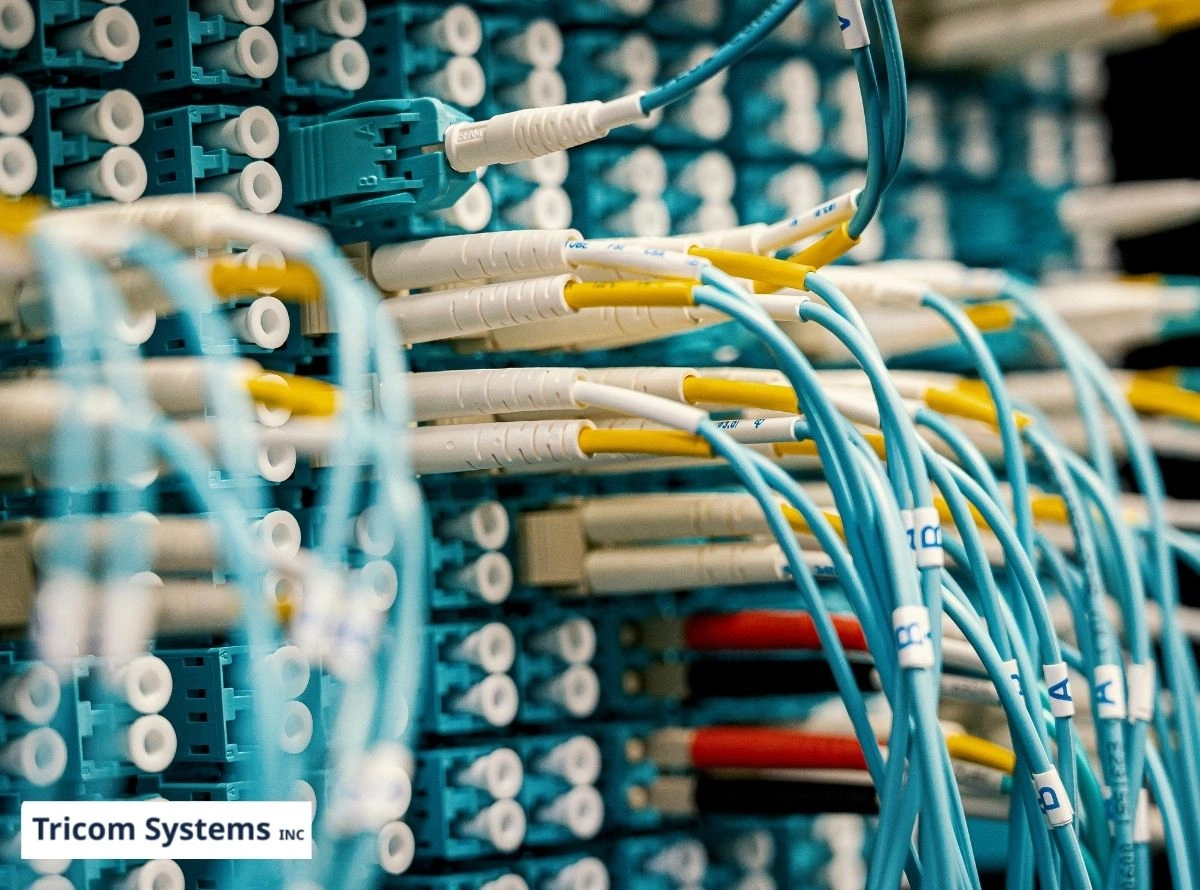
Fiber optic cable transmits data using light pulses through thin glass or plastic strands instead of electrical signals through copper. That fundamental difference is what gives fiber its performance advantages.
Speed that scales. Fiber supports speeds from 1 Gbps to well over 100 Gbps, depending on the equipment on either end. For businesses growing their digital operations, fiber provides headroom that copper simply cannot match.
Distance without degradation. Fiber optic cable can carry signals over much longer distances, often several kilometers, without the signal loss that limits copper runs. In large facilities, warehouses, or campuses with multiple buildings, this is a significant advantage.
Immunity to electromagnetic interference. Because fiber uses light instead of electrical signals, it is completely unaffected by the interference that plagues copper in older or electrically dense environments. No more unexplained drops caused by a fluorescent light ballast two feet from your cable tray.
Higher bandwidth capacity. Fiber can handle more data dramatically simultaneously. When your business is running hosted VoIP phone systems, cloud applications, security camera systems, and data backups on the same network, fiber ensures none of those systems are fighting each other for bandwidth.
Longer lifespan. Fiber infrastructure is more durable and less susceptible to environmental degradation. A properly installed fiber backbone can serve your business for 20 to 30 years, whereas copper cabling often needs replacement or supplementation within 10 to 15 years as technology demands increase.
The Cost Question Everyone Asks
Yes, fiber optic cable costs more to install than copper. The materials are more expensive, the termination process requires specialized tools, and the labor takes more precision. For a small office with straightforward needs, the premium may not be justified today.
But cost should be evaluated in context
- The price gap has narrowed significantly. Fiber installation is far more affordable than it was even five years ago. For many businesses, the difference between a copper and fiber buildout is smaller than they expect.
- Operational savings add up. Fiber requires less maintenance, experiences fewer failures, and does not need to be replaced as technology evolves. What costs more on day one often costs less over a five to ten-year window.
- Retrofitting later costs more than doing it now. If your business is moving, renovating, or expanding, installing fiber during construction is a fraction of the cost compared to tearing open walls and ceilings after the fact.
- Downtime has a price tag. Every hour your network underperforms or goes down costs your business in productivity, missed calls, and frustrated customers. Fiber’s reliability reduces those incidents significantly.
Which One Is Right for Your Business?
There is no blanket answer. The right choice depends on your specific situation.
Copper cabling is likely sufficient if
- Your office is under 5,000 square feet with a small team
- Your bandwidth demands are moderate, covering basic internet, email, and standard phone use
- Your current cabling is Cat6 or Cat6A and was professionally installed
- You are not planning significant growth or technology upgrades in the next few years
Fiber optic cable makes more sense if
- Your business relies heavily on cloud platforms, video conferencing, and large file transfers
- You are running business VoIP phone systems and security camera systems on the same network
- Your building has long cable runs or multiple floors, where signal degradation is a concern
- You are moving into a new space, renovating, or expanding your current office
- You want infrastructure that will not need replacing as your technology needs grow
Many businesses are finding that a hybrid approach works best. Fiber serves as the backbone connecting floors, server rooms, and high-demand areas, with copper runs handling individual workstations. A smart network cabling services provider will help you design that mix based on your building and your budget, rather than pushing all-fiber when you do not need it.
The Bottom Line
Your cabling infrastructure is the one thing every system in your office depends on. Phones, internet, security, cloud tools, none of it performs better than the cables carrying the data. Choosing between fiber optic and traditional copper is not about chasing the newest technology. It is about matching your infrastructure to how your business operates today and where it is headed tomorrow.
Make the decision based on your actual needs, your building, and your growth plans. And get a proper assessment done before committing either way.
Frequently Asked Questions
Is fiber optic cable faster than traditional copper cabling? Yes. Fiber supports significantly higher speeds and greater bandwidth capacity than copper. While Cat6 copper can handle up to 10 Gbps over short distances, fiber can deliver speeds well beyond that over much longer runs without signal loss.
Is fiber optic internet worth the cost for a small business? It depends on your usage. If your business relies on VoIP, video conferencing, cloud applications, and connected security systems, fiber delivers the performance and reliability that justifies the investment. For lighter usage, upgraded copper cabling may be sufficient.
Can fiber optic and copper cabling be used together? Absolutely. Many businesses use fiber as the backbone for connecting floors or buildings and copper for individual workstation runs. A hybrid approach gives you fiber’s performance where it matters most without the cost of an all-fiber buildout.
How long does fiber optic cabling last? A properly installed fiber optic infrastructure can last 20 to 30 years. Fiber is more resistant to environmental wear, electromagnetic interference, and bandwidth obsolescence compared to copper, which typically needs evaluation or replacement within 10 to 15 years.
How do I know if my current cabling is causing performance issues? Common signs include inconsistent internet speeds, poor VoIP call quality, security camera lag, and network drops in certain areas of your office. A professional cabling assessment can identify whether your infrastructure is the bottleneck.
Tricom Systems Inc. has been building reliable network infrastructure for Connecticut businesses for over 20 years. Whether you need a full fiber buildout, a copper-to-fiber upgrade, or an honest assessment of what your current cabling can handle, our team designs every installation around your building and your business, not a template.
Learn more about our fiber optic cabling solutions, explore our full range of business telephone systems, or contact the Tricom Systems team to schedule your infrastructure assessment today.